
Energy Intelligence for Every Building

Updated: Jul 23

Small and mid-size retail buildings represent over 90% of U.S. commercial properties—and AI-powered energy management is turning that scale into a competitive advantage.
SPONSORED CONTENT
The real opportunity for energy efficiency lies not in sprawling corporate campuses or massive industrial complexes, but in the places consumers visit every day: the local grocery store, the quick-service restaurant (QSR), and the mid-size retail outlet. Yet for years, these businesses have operated without the tools needed to truly understand—or control—their energy spend.
Small and mid-size buildings represent over 90% of U.S. commercial properties. Individually, their footprint might seem modest, but collectively they account for a significant share of national energy consumption and CO2 emissions. For multi-site facilities teams, this creates a dual challenge: protecting profit margins while navigating mounting pressure to decarbonize and comply with increasingly strict environmental regulations.
The traditional narrative held that sophisticated building management systems (BMS) were too complex or costly for smaller footprints. That landscape is changing rapidly. With the emergence of AI-powered Software as a Service (SaaS) solutions, the barrier to entry has dropped dramatically —giving retail and food service businesses access to enterprise-grade energy management without the enterprise price tag.

Profitability challenges
In the high-stakes world of U.S. retail and food service, downtime is not an option. A refrigerator failure in a supermarket means thousands of dollars in spoiled inventory. An HVAC malfunction during a summer heat wave not only drives customers away but can also create unsafe working conditions for employees.
For too long, facility management has been reactive—fixing things only after they break. With utility rates rising sharply across the country, energy waste compounds quickly across multiple locations. Without real-time insight, inefficiencies go undetected for weeks or months. This lack of visibility is a silent profit killer, made significantly worse by:
Soaring labor costs: High labor expenses pressure facilities teams to reduce costly truck rolls for routine maintenance and remote diagnostics.
Extreme weather: Severe swings—from polar vortexes to record-breaking heat waves—push HVAC systems to their limits, increasing failure risk and driving up energy costs at the worst possible times.
Regulatory demands: State-level energy disclosure laws in California, New York, and Washington require precise tracking and reporting. The AIM Act’s refrigerant phase-down, which began in 2025, demands careful ongoing management of all cooling assets.
Health and wellness expectations: The post-COVID era has brought increased focus on indoor air quality (IAQ), making continuous environmental monitoring a core expectation for customers and staff alike.
Cloud-based management
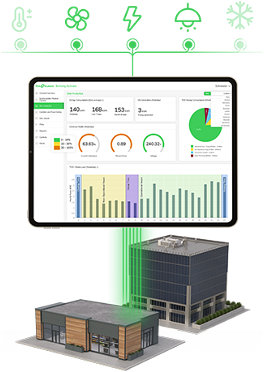
The solution isn’t just about installing better hardware—it’s about unlocking the data that already exists within a building’s systems. The new wave of building technology is automated, cloud-based, and engineered for simplicity. EcoStruxure™ Building Activate by Schneider Electric exemplifies this shift. Designed specifically for small and mid-size facilities that may not have dedicated on-site maintenance staff, it aggregates data from HVAC, lighting, and refrigeration into a single, intuitive dashboard—turning raw readings into actionable insight.
This platform puts capabilities previously reserved for large enterprises within reach of every operator:
Prevent costly equipment failures: Around-the-clock monitoring detects anomalies early and sends alerts, enabling teams to address problems before they escalate into downtime or spoilage.
Automate compliance: Temperature, air quality, and energy data are logged and reported automatically, supporting tightening regulatory requirements and ESG reporting obligations.
Cut energy waste across all sites: Smart automation reduces energy demand by up to 24% while maintaining comfortable conditions for customers and staff.
Resolve most issues remotely: Real-time visibility allows facilities teams to diagnose and resolve up to 90% of issues without dispatching a technician—significantly reducing operational costs.
Maintain healthy environments: Continuous monitoring of temperature and IAQ keeps conditions safe and consistent across every location in a portfolio.

Ready operations for the future
The urgency to modernize extends well beyond current savings.
As retail locations increasingly become hubs for electric vehicle (EV) charging, the load on electrical infrastructure will grow substantially. Managing that demand requires a smart, integrated approach to load management—preventing outages and avoiding costly peak demand charges.
Adopting a scalable digital platform today lays the foundation for the energy demands of tomorrow. Whether integrating rooftop solar, managing EV chargers, or simply keeping equipment running at peak efficiency, the path to long-term resilience starts with one thing: visibility.
EcoStruxure Building Activate helps retail and food service operators drive efficiency, reduce costs, and build the infrastructure needed for long-term growth.


Comments