
The Blueprint and Back Again: How Tech and FM Data Are Changing Building Lifecycles

Industry Highlights | Tim Ballard | ConnexFM
In 2024, the National Academies published a report noting that operations and maintenance typically account for roughly 70–80% of an asset's total lifecycle cost. No surprises there, seeing as we're talking about the actual day-to-day functions of a commercial facility. No, the real question is this: If operations and maintenance account for the majority of a building's lifecycle costs, why isn't more of the data and operational protocols generated within FM being fed back into aspects like design decisions, construction, or the hand-off process from one owner to the next?
The answer? Thanks to the power of 21st-century data-tracking technology, we already are... sort of. The technical ability to do so has been around for more than a decade. With BIM, CMMS, smart building systems, and now AI, all the pieces are out of the box. Now, we are in the beginning stages of trying to assemble a normalized way to relay this information from one involved party to the next, regardless of whether they're an engineer, an architect, a real estate professional, the maintenance staff, or the owner of the facility. There are a few hang-ups that we're running into, like making data that is standardized for a single industry translatable for several industries. But if we could leap over some of these hurdles that are preventing the regular collaboration of industries and information, the world of facilities management becomes our oyster.
The Grand Scheme of Things
The National Institute of Standards and Technology (NIST), a champion of standardized information exchange and interoperability, gave us an example of just what we stand to lose without learning how to talk to each other.
In its research, NIST estimated that facility owners and operators were spending roughly $4.8 billion a year verifying that their documentation accurately represented existing conditions.
Another $613 million was spent simply transferring that information into a usable format. Let's set inflation aside for a second, because that's a big number even by today's standards, and it's a problem we are still encountering in modern FM.
That wasn't even where the biggest chunk of the estimated cost was coming from. NIST's study estimated that inadequate interoperability was responsible for roughly $9.1 billion in annual costs during operations and maintenance, compared with about $4.1 billion during construction and $2.7 billion during planning, design and engineering.

Costly story made short, the further a building moved into its lifecycle, the more expensive the consequences of disconnected information became. It's a big part of why the industry has spent years trying to figure out better ways for all of this information to talk to each other.
Lost in Translation
Fast forward a ways to the 2020s. Different industries have access to different tools now to help create a benchmark for what is, and in a sense, what was. The problem, though, is that each industry with each tool is just one piece of the puzzle. Because data representation, and by extension the data standards it creates, are often centered around a particular function or phase of the building lifecycle, the rest can be left in the peripheral or thrown out altogether.
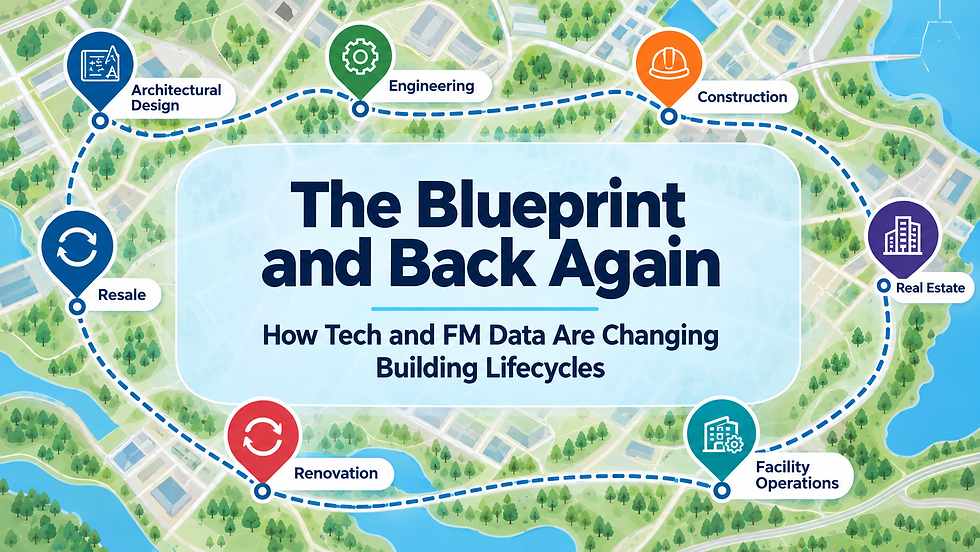
An architect may have a highly detailed digital model of a building. A contractor may have another set of information documenting what was actually installed. The FM team may have years of work orders, maintenance records and equipment histories. A real estate professional may have information about the property itself, its occupants and its transactions. All of that information can be useful. But useful information isn't necessarily interoperable information.
This brings us to the crux of the challenge: getting these standards to sit around the big table and speak the same language.

Purpose and Potential
The good news is that we're not exactly starting from scratch. There are already systems and software designed to organize and translate information across different stages of a building's lifecycle. These aren't necessarily even rudimentary systems either, because they can create a bridge from one phase of the lifecycle process to the next, but we're still seeing many of these systems in their infancy when it comes to interoperability across the entire lifecycle. What we're currently facing with these systems however, is how do we utilize them beyond the here and now of the current phase of a facility's lifecycle. Particularly, how we take information from the largest, most costly part of that lifecycle, like work order history, asset age for systems, or even the personnel who were a part of preventive maintenance, and turn it into something that is both understandable, and actionable for the other industries involved? If they had that kind of power, architects could design around supporting a facility's aging needs better, engineers could create with maintenance challenge points in mind, and even real estate professionals would have access to a more refined and more detailed report on what went down in the facility since the lights first came on.

What the Data Means Versus What it Is
The building doesn't stop generating information when construction is finished, and that information shouldn't stop being useful when it changes hands. If we're serious about getting more value out of every stage of a building's lifecycle, we need to start treating the data generated along the way as part of the asset itself. That means building common standards, encouraging collaboration between industries, and making sure the lessons learned in operations can find their way back to the people designing, building, buying and renovating the facilities of tomorrow.
We have the tools. We collect the data. Now it's time to put that data to purpose and start looking at the entire building lifecycle, and the information we collect around it, as parts that can improve the whole. Join us for FutureBuilt on November 12th, 2026 and be part of furthering the conversation and purpose of data and technology that will change the way the built environment functions.


Comments